
“Running has saved me over and over and over again.” (Froelich)
When we consider what it means to take care of our mental health, we often think about what is happening in our minds. It’s our thoughts, emotions, how we perceive life, and the experiences that have shaped us. When we think about what helps us navigate the ups and downs of what happens in our minds, we may think about therapy, medication, mindfulness, or other tools. But what we sometimes forget is the significance of two things: the mind-body connection and community.
Stress has an interesting way of reminding us that our minds and bodies aren’t separate. After a difficult week, we might notice the tension in our shoulders, back, jaw, or hips before we’ve even acknowledged how stressed we actually are. Has anyone ever had a really intense week and then gotten sick right in time for the weekend or right before that vacation? Sometimes it feels like our body is responding by saying, “You can’t keep doing this to me.” If we don’t learn how to release some of that tension, our bodies can find their own ways of reminding us that we need to slow down and pay attention.
When stress becomes prolonged or overwhelming, it can also be closely connected to our experiences of trauma and the ways those experiences continue to affect us. Trauma is what happens to us, and its effects are not always limited to a single moment in time. We may continue to experience its impact in one way or another long after the event itself has passed. Trauma can affect the body in many ways, contributing to physical symptoms such as muscle tension, chronic pain, fatigue, and changes in how our bodies respond to stress. Sometimes our bodies are practically screaming at us that we are stressed while our minds are saying, “Oh, but I’m fine. Everything’s fine.”
The concept of movement can be one catalyst for helping us respond to some of the physical and emotional stress we carry.
Running, walking, stretching, yoga, cycling, strength training, and other forms of exercise have all been associated with improvements in symptoms of anxiety and depression. There is something valuable about getting outside, moving our bodies, and making a conscious effort to step away from the environments that are constantly producing stress for us. Even sunlight exposure supports our overall health, including vitamin D production, and low vitamin D levels have been associated with symptoms of depression and anxiety.
Of course, movement and getting outside can look very different depending on someone’s circumstances and the season of life they’re in. The goal isn’t perfection. Sometimes five minutes is just enough! Sometimes a walk around the block is the most ambitious thing we can manage—and that counts, too.
But there’s another aspect of our overall health that is pivotal: community.
The Harvard Study of Adult Development, one of the longest-running studies of adult life, has found that strong relationships and quality social connections are among the strongest predictors of happiness, health, and longevity. It’s not fortune, and it’s not fame. It’s connection.
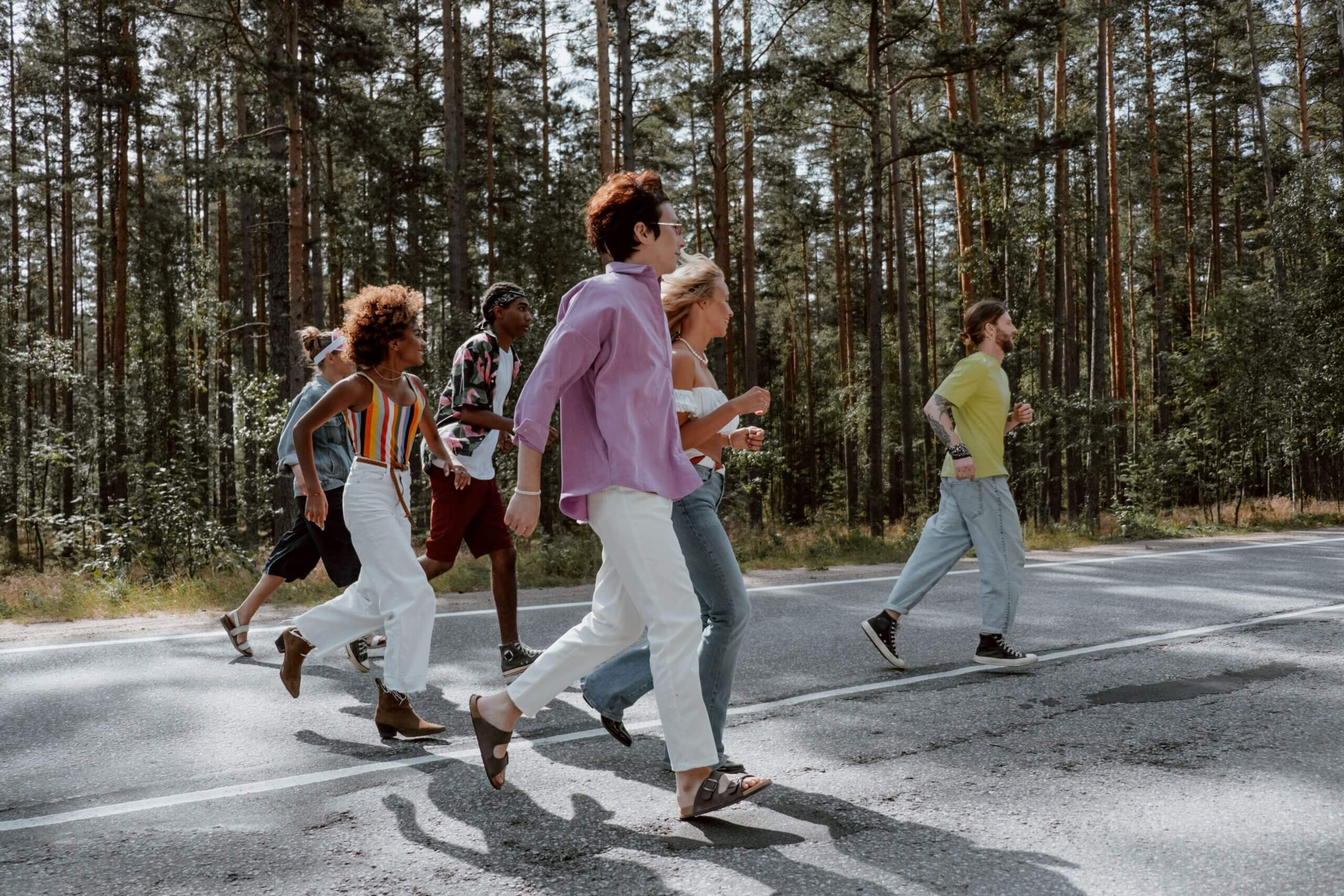
I recently joined a running group in the area and after one of our first runs of the season, I found myself talking to another runner about mental health. As we talked, he held his hand out in front of him and moved it back and forth, almost as though it were balancing on the edge of something.
“I teetered on the edge of depression all my life,” he said.
He went on to tell me, “Running has saved me over and over and over again.”
That conversation stuck with me. It wasn’t simply that running had helped him move away from thoughts of hopelessness. It was also about being part of a running group where he felt he belonged. Maybe for him, it wasn’t just the miles he accomplished. Maybe it was the conversation before the run. The laughs in between breaths. In knowing that every Tuesday at 6:00, he’s expected to show up. It’s having someone notice when he hasn’t been coming.
With running groups, and with so many other forms of community, it’s not only about accountability. Sometimes it’s simply knowing that we’re not navigating this life entirely on our own.
And perhaps that’s where the mind-body connection and community come together. Moving our bodies can help us feel better physically and emotionally, while doing it alongside others can remind us that we are connected, supported, and part of something bigger than ourselves.
Taking care of our mental health does not always have to feel like work. Sometimes self-care can look like a walk outside with a friend, stretching in your living room while watching your favorite show, or finally showing up to the yoga class you’ve been talking about trying.
Maybe today it’s simply taking a moment to ask yourself, “What is my body trying to tell me?” and “Who can I talk to about it?”
Whatever it looks like for you, the charge is simple: get out when you can, get connected in a way that feels meaningful to you, and give yourself permission to have a little bit of fun while you’re at it.
PS. Click here for a list of running groups in Richmond