Hours of Operation Mon – Thu: 8AM – 6PM | Fri: 8AM – 4PM | Sat – Sun: Closed
Call or Text: (804) 303-9622
In case of emergency, call 911
Hours of Operation Mon – Thu: 8AM – 6PM | Fri: 8AM – 4PM | Sat – Sun: Closed
In case of emergency, call 911
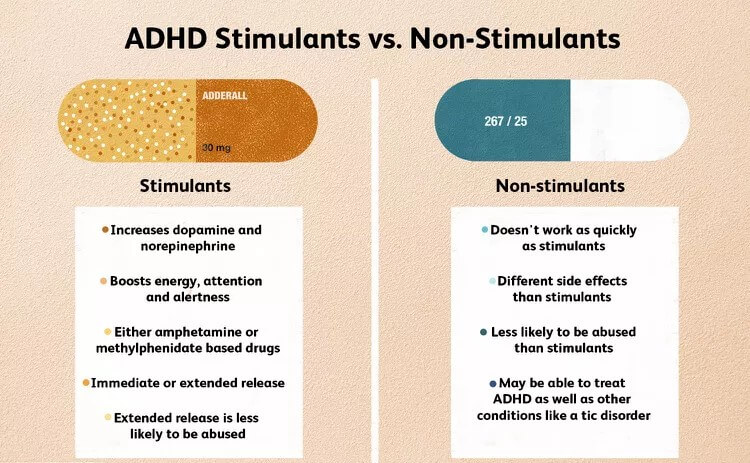
Stimulant and non-stimulant ADHD medications differ in how fast they work, how they affect the brain, and their risk levels.
Stimulant ADHD medications fall into two main categories and are often considered first-line treatments because they are effective for many people with ADHD. Many stimulant medications come in short-acting vs. long-acting (extended-release) forms, which differ in how fast they work, how long they last, and how often you need to take them.
Methylphenidate-based ADHD medications work by increasing the availability of certain neurotransmitters involved in attention and self-control. Common examples include:
Amphetamine-based ADHD medications work by also affecting neurotransmitters that help regulate focus, impulse control, and alertness. Common examples include:
Non-stimulant ADHD medications are widely used for the treatment of ADHD in children and adults. They can be effective in reducing ADHD symptoms by modulating norepinephrine and dopamine levels to improve focus and control impulses. Unlike stimulant medications, non-stimulants are not controlled substances. Common examples include:
The choice between stimulant and non-stimulant medication is individualized. Many clients do very well on stimulants, while others achieve excellent results with non-stimulants or a combination approach guided by our psychiatric nurse practitioners.
Important Notes:
Disclaimer: This content is provided for informational or educational purposes only. It is not intended to be a substitute for informed medical advice or care. You should not use this information to diagnose or treat any health issue without consulting your healthcare provider.
Sources:
We offer counseling and psychiatric medication management services that allow individuals to meet their mental health goals through clinical care that is respectful and collaborative.
Same-day access to mental health services is available at all Virginia CSBs
Suicide & Crisis Lifeline: Call or Text 988
MHAV’s Warm Line: 1 (866) 400-6428
Crisis Text Line: Text “HOME” to 741741
Zoe Therapy Services – Innslake
4191 Innslake Dr, Ste 211
Glen Allen, VA 23060
Zoe Therapy Services – Forest
7201 Glen Forest Dr, Ste 304
Richmond, VA 23226
Zoe Therapy Services – Southside
2808 Fox Chase Lane
Midlothian, VA 23112

Hours of Operation
Mon–Thu: 8AM–6PM | Fri: 8AM–4PM
Sat–Sun: Closed